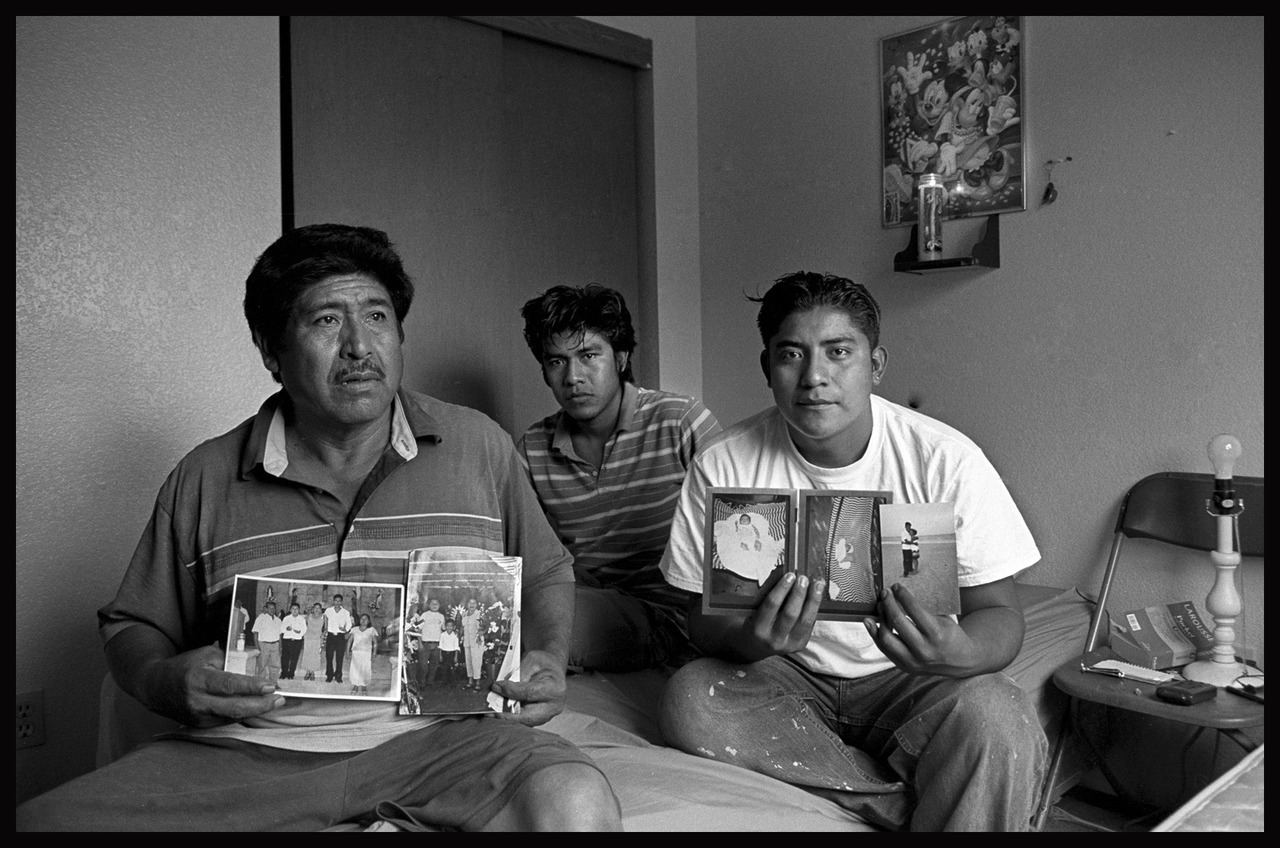
At first glance, one can see three men who appear to be of a Hispanic heritage. The two younger men are looking directly towards the camera, while the oldest seems to be gazing off to the right. This difference in eye direction could signify the past struggle that he has had to face that the younger two haven't, to that extent, faced themselves.
Furthermore, I found it quite intriguing that this photo seems to utilize the "othering" aspect on the surface, rather than subliminally. By this I mean, at first glance, the audience is lead to believe that the men in this photo are unlike them. Little details within the room such as: the bare bulbed lamp resting on a tin folding chair, the bare mattress that appears to be lying on the floor, and even the bare small room that they are sitting in, causes the average American citizen, or the audience, to lose the ability to relate and therefore distance themselves which results in the "othering" aspect.
However, on a deeper level, the photograph conveys a completely different message. The audience begins to recognize that the men in the image are more similar than once thought. From the paint splatters on his jeans which implies hard working, and the images of family, the audience is able to conclude that the men in the image are more like them than different.
As far as within The Handmaid's Tale, othering is used on numerous occasions throughout the novel. One of which being when Offred initially describes Ofglen. She states, "...that's about all I know about her. She walks demurely, head down,...hands clasped in front, with short little steps like a trained pig's, on its hind legs" (Atwood pg. 30). By describing Ofglen in such a manor, the reader is made to believe that Ofglen is the outcast or unimportant. This strategic use of othering toward Ofglen automatically persuades the reader into believing that Ofglen will play a minimal role in the novel. However, we know that this contributed to a classic case of situational irony.
Overall, othering contributes to the way in which the audience feels towards a subject as well as the response evoked within them.
Wing Young Huie: Father and Sons, The Springs, California (2007)